The actual problem
German data centres consumed 21.3 billion kilowatt hours in 2025; installed IT connection capacity grew nine percent to 2,980 MW. For 2030 the industry association expects 5,000 MW.1
That capacity has to connect somewhere. Because data centres cluster at a few network nodes, many connection requests meet the same limited capacity there — the same pattern as with storage, where around 574 GW was requested and 54 GW offered in 2025.2
Storage does not solve this entirely. But it shifts the question: instead of peak power, only average power has to come from the grid.
What storage actually contributes
| Contribution | Effect | Prerequisite |
|---|---|---|
| Lower connection capacity | the capacity applied for follows average rather than peak load | robust site load profile, agreement with the grid operator |
| Shave peaks | lower capacity charge in the grid fee | predictable or quickly detectable peaks |
| Integrate generation | on-site solar becomes usable outside generation hours | land or roof for generation, a co-location concept |
| Provide grid services | additional revenue from free capacity | grid-forming inverters, prequalification, spare capacity |
| Bridging | complement to or partial replacement of conventional backup concepts | agreement with the operator's safety concept |
Storage does not replace an uninterruptible power supply meeting availability-class requirements. It complements it and can take on parts of it — what applies in each case belongs in discussion with the operator, not on a website.
Edge sites
Not every data centre is a hyperscale campus. Small distributed units at industrial sites, substations or generation plants process data where it arises.
For such sites the same logic applies at smaller scale — with the difference that a grid connection often already exists. An edge site next to an existing storage or generation project can share its connection.
On efficiency requirements
German data centres are subject to efficiency requirements, including on power usage effectiveness. We will quote specific limits and dates here once we can evidence them from the applicable version of the act — the legal position in this area has changed several times.
What holds regardless: storage does not improve PUE. It improves the connection situation and the cost structure. Conflating the two sells something other than what is delivered.
Common questions about storage at data centres
The difference between backup power and grid connection is what gets confused most often here — so it comes first.
Why does a data centre need battery storage?
Not for availability — there are already an uninterruptible power supply and a standby generator for that. It is about the grid connection: a data centre needs connection capacity for its peak but draws considerably less on average, and storage closes that difference. In Germany this is precisely the bottleneck — in 2025 German data centres consumed 21.3 billion kilowatt-hours at 2,980 MW of installed IT connection capacity, with 5,000 MW expected for 2030.1
How does this differ from a classic UPS?
An uninterruptible power supply bridges seconds to minutes until the standby generator starts; it is built for availability, not for energy. Storage is dimensioned the other way round: plenty of energy, but without the availability chain of a UPS. It can take over parts of a backup concept but does not replace it. What applies in a given case belongs in the discussion with the operator and in their safety concept, not on a website.
How does storage help when connection capacity is too low?
The capacity applied for then follows average rather than maximum load. In practice the system covers the peaks out of itself and recharges in the troughs, so that a flatter curve arrives at the connection point. This requires a credible load profile for the site and the grid operator's agreement to that mode of operation — without it, the calculation has no effect. In addition, section 17(2b) EnWG has since February 2025 allowed a flexible connection in which output is curtailed for a few hours a year.3
How large does the system have to be for a data centre?
It follows from the load profile, not from IT capacity. The same four quantities matter as at any industrial site: the gap between peak and average, frequency, duration and the time available to recharge. A data centre's profile is flatter and more predictable than a factory's — which makes design easier, but the saving from pure peak shaving smaller too. How the calculation works in principle is shown by the tool on the industrial page.
Where does the storage go — inside the building or beside it?
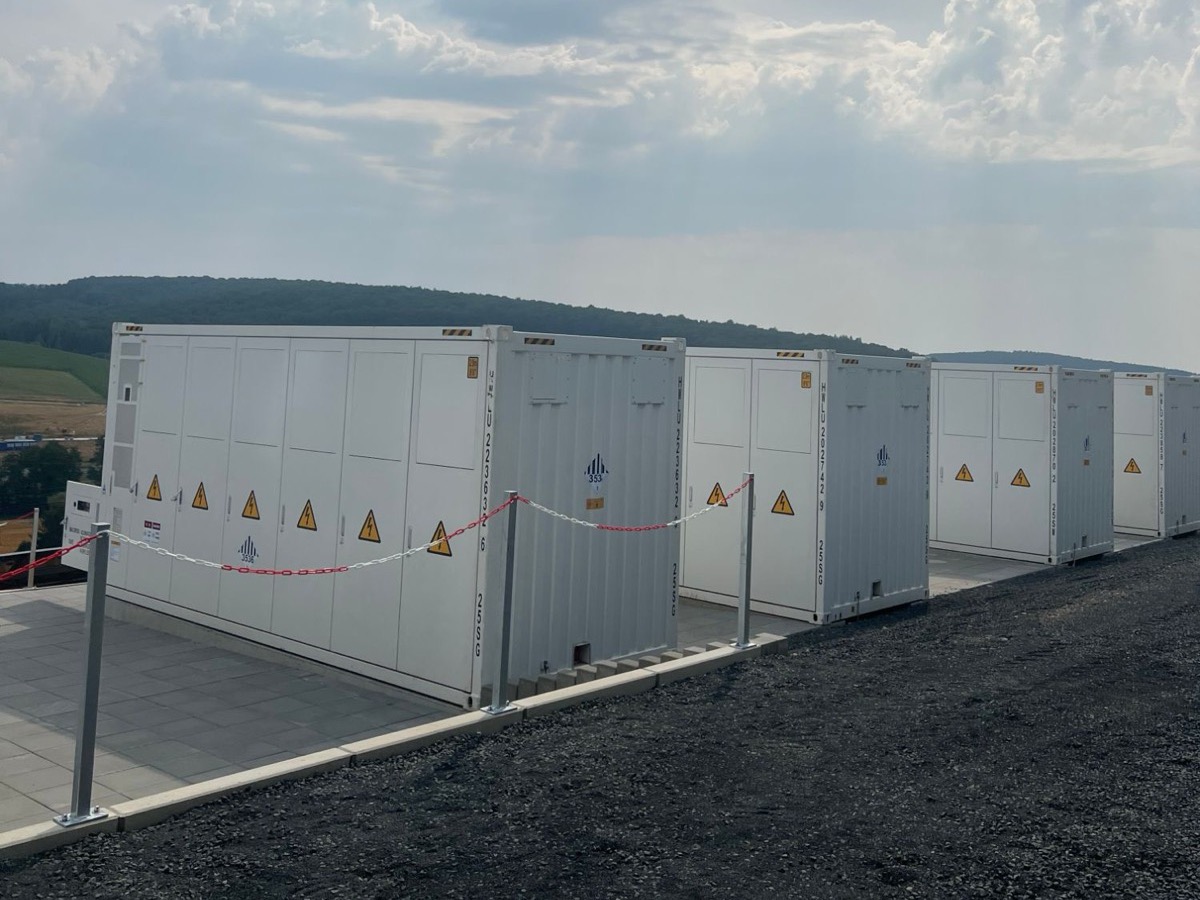
Beside it, in its own containers on a hardstanding, with its own fire compartment and transformer station. Installation inside the building is technically possible but sharpens fire protection and smoke extraction considerably, and is rarely sensible at the capacities in question here. The footprint is small measured against the campus; what decides the layout are separation distances and heavy-load access.
What does the PUE requirement mean for power supply?
Efficiency requirements apply to data centres, among them power usage effectiveness. We will name specific limits and dates only once we have evidenced them from the law as it stands — the legal position here has changed several times. Independently of that: storage does not improve PUE. It improves the connection situation and the cost structure; anyone who conflates the two is selling something other than what they deliver.
Can the system also be used on the market?
Yes, with the capacity left after own requirements. This requires prequalification, a marketing contract and, depending on the product, Grid forming inverters. Two limits apply as at any behind-the-meter site: the site function takes priority, and trading raises the cycle count and with it ageing. As the foundation of an investment decision this does not work; as a contribution to operating costs it does.
Does this also apply to small edge sites?
Yes, on a smaller scale — and often with one decisive difference: at such sites the grid connection frequently already exists. An edge site next to an existing storage or generation project can share its connection; that is the same co-location logic as with photovoltaics, only with compute load instead of feed-in. It does not shorten the technology, but it shortens the route to the grid — and here that is the longest item.
Sources
Sources last reconciled on
- Bitkom e. V.: Data centres in Germany: current market developments (update 2025). As of 2025-11. Go to source
- Bundesnetzagentur (Monitoring), berichtet von pv magazine: Grid connection requests and offers for battery storage in 2025. As of 2026-08-25. Go to source
- Kapellmann Rechtsanwälte (Erläuterung des Gesetzes): Flexible connection agreements and cable pooling under the Solar Peak Act. As of 2025-02-25. Go to source